How to Choose a Church Website Agency

Not every agency that says it builds church websites actually specializes in them. Here's what to look for and the questions to ask before you sign anything.
There are more church website agencies than ever. Some work only with churches. Others do general web design and list "churches" somewhere on their services page. A few mention "ministry" on their About page and call it church experience.
Picking the wrong one costs more than money. It costs months of your team's time, and you can end up with a site that still doesn't feel like your church. Before you sign anything, here's what we'd look for.
Look for a portfolio of church websites
Ask to see church websites they've built, not just the projects they're proudest of. Look for churches close to yours in size, style and structure. If you're multi-campus, ask to see a multi-campus site. Then ask yourself whether the sites look distinct from each other, or like the same template with different photos.
If an agency can't show you at least five church websites from the last two years, they're probably a general agency that sometimes works with churches.
Good church websites don't just look nice. They're built around how a first-time guest moves through the site, from curious to planning a visit. Ask the agency to walk you through that path on one of their own sites.
Ask how they think, not just how long it takes
Every agency will hand you a timeline. What you want to know is how they approach the work.
Ask them how they figure out the strategy behind the site, what they'll need from your team and when, how feedback rounds work, and what happens if you go over scope. A good agency can walk you through discovery, sitemap, wireframes, design, development and launch without having to think about it. "We're flexible and collaborative" sounds nice but tells you nothing.
Know what platform they build on, and why
Most churches forget to ask this, and it affects almost everything: how fast the site loads, how secure it is, how easy it is for your staff to edit, what's possible design-wise, and what you'll pay every month after launch.
Some agencies build on WordPress. Others use church platforms like Subsplash or Ekklesia 360. We build only on Webflow, and we're happy to explain why. Whatever the answer, ask what the tradeoffs are and what happens if you ever want to leave. "Everyone uses it" isn't a reason.
If you're weighing platforms yourself, our WordPress vs. Webflow comparison is a good place to start.
Make sure your team can edit the site after launch
A site your staff can't update goes stale fast, and stale information is one of the quickest ways to lose a first-time guest's trust.
Ask who will make updates after launch, what that takes, and whether they'll train your team. Some agencies build sites that are hard to edit so you keep paying them for small changes. A good agency builds for your independence and offers ongoing support as an option, not a requirement.
Get clear on pricing before you sign
Church websites range from a few thousand dollars to well past $25,000, and the gap reflects real differences in customization, strategy and process. Make sure you know what you're buying.
Ask for an itemized proposal. What's included and what isn't? Are there ongoing fees for hosting, licensing or maintenance? What counts as a change order? If an agency can't give you a straight answer on price, expect the same on everything else.
Look for a partner, not just a vendor
It might sound like a cliché, but it matters. A vendor does what you ask and moves on once the work is delivered. A partner is invested in what you're trying to accomplish. They ask questions, solve problems with you, and tell you when something won't serve your church well.
Pay attention to how an agency treats your ideas in the first few conversations. You know your church, your community and your people in ways an outside team never will. A good partner listens for that and builds on it. Honestly, this is one of our favorite parts of the work. Our clients bring knowledge about their church that we don't have, and the best sites come from putting their ideas and our experience on the same table.
This matters long after launch, too. A website keeps changing as your church grows, adds ministries, opens campuses and shifts what it emphasizes. You want an agency you enjoy working with and who stays invested in your goals over time, because that relationship will shape your website for years, not just for the first few months.
Red flags
- No church-specific portfolio, or every site looks the same
- No clear reason for the platform they use
- A vague timeline like "a few months" with no process behind it
- They agree to everything and never ask why
- No training or handoff plan
- A price that seems too good to be true. A $1,500 church website is usually a template with your logo on it, or a project that will run over budget
Questions to ask on a discovery call
- Can you walk me through your full process?
- What platform do you build on, and why?
- How will our staff update the site after launch, and will you train us?
- Can you integrate with the tools we already use, like Planning Center, Rock RMS or our giving platform?
- What's included in your price, and what triggers a change order?
- What does working together look like after launch?
- Can you show us 3–5 church websites you've launched recently?
- How long does a typical project take from kickoff to launch?
How we'd answer those questions
Fair is fair, so here are our answers.
Sunday Best works only with churches and ministries. We've designed and built more than 30 church websites, from church plants to large multi-campus churches like The Austin Stone and Menlo Church. Every site is custom designed (no templates) and built on Webflow. Most projects take 3–4 months, and our packages and starting prices are published on our pricing page.
Every project starts with strategy: goals, a sitemap and wireframes, before any design work begins. Your team signs off on each stage before we move to the next one. At launch, you get training and a handbook with video tutorials so your staff can update sermons, events and pages on their own. If you want ongoing help, our maintenance plans cover updates, broken-link checks and a monthly site health report.
We also know the church tech stack well. We regularly connect sites to Planning Center, Rock RMS, Subsplash and other church tools so your team isn't entering the same event in three places.
Take your time with this decision and ask good questions. Then look for the agency that can show you the work, not just describe it. You can start with what we've built or read through our process.
Related Resources
Can AI Build Your Church Website? Why You Still Need an Expert
AEO for Churches: How to Get Found in the Age of AI Search

How to Make the Case for a New Church Website to Your Leadership

How to Choose a Church Website Agency

Local SEO for Churches: How to Show Up When People Search
Church App vs Church Website: Do You Need Both?
Church Website Accessibility: A Practical Guide for Welcoming Everyone Online
How Much Does a Church Website Cost? A Transparent Pricing Guide

WordPress vs Webflow: Why We Build Every Church Website on Webflow

Is Webflow Secure? Why Churches Can Trust Webflow for Their Website

The Ultimate Church Photography Guide
Your Church Website is the New Front Door

5 Advanced Webflow Features Large Churches Can Leverage

Visiting a Church for the First Time is hard
5 Things Every Church Website Should Include
Multi-Campus Church Websites

The Most Important Page on your Church Website
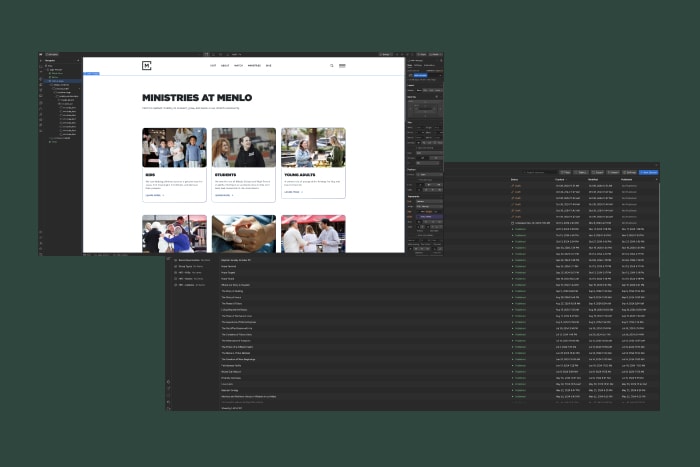
How to Edit Your Church Website in Webflow
Best Church Website Builders in 2025: A Complete Guide
SEO: A Guide for Churches

How to Write Great Website Copy

Custom vs. Template Church Websites
What is Webflow? The Best Platform for Church Websites
The Best Church Websites of 2024

Who is Your Church Website For?


Are you ready?
